
TL;DR
This could’ve been helpful...but it wasn’t. Dead.
Quick Intro
While staying in a hotel, I came across this mirror in the bathroom. It had two sides: one that displayed a regular reflection and one that was magnified.
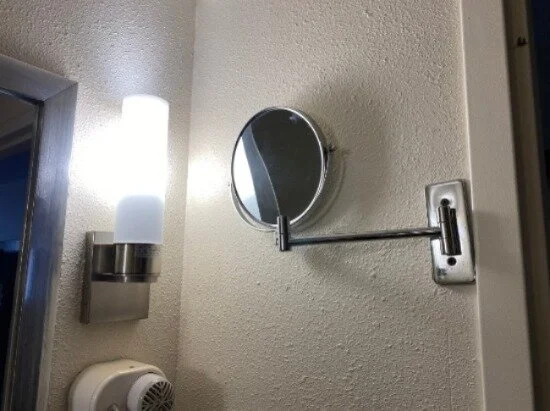
Image of the two-sided mirror attached to a metal arm that’s been drilled into the wall.
My Goal
After getting dressed that day, I wanted to put on some mascara and I thought this would be the mirror to help me get that done. Spoiler alert: it was not.
My Experience
Once I got dressed and did my hair, the mascara came next. I was planning on using the regular bathroom mirror that was above the sink but once I saw this additional mirror, I figured it’d be perfect to use to get a closer look at my eyes while applying my makeup.
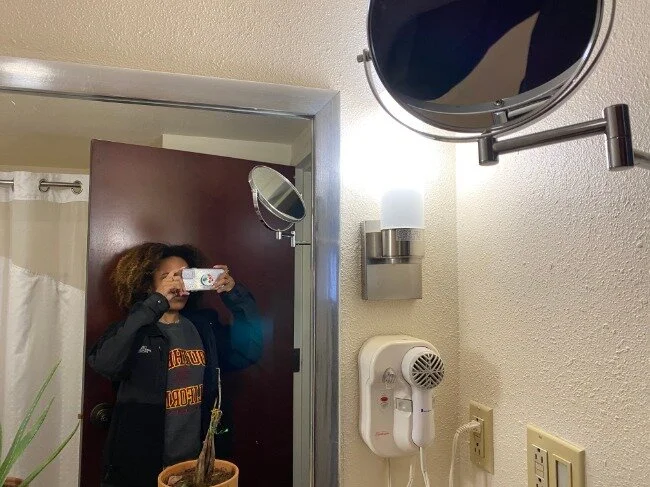
Image of the two-sided mirror attached to a metal arm that’s been drilled into the wall and myself in comparison to its height.
I stand at a very solid 5’2” tall. I’m not sure how high this mirror was installed but it was clearly not short enough for me to use effectively. “That’s alright,” I thought to myself, “I’ll just adjust the height.” *insert foot in mouth emoji here* It was not adjustable.
I can only conclude that the people who installed this mirror (or those that made the decision on where on the wall the mirror would be installed) didn’t give one f*ck about other humans my height and under. Hell, I don’t think it’d be suitable for anyone under 5’6”, if we’re being honest. I’m also not great at estimating heights, so...that number might not be exact but I think my point has been made.
Needless to say, I ended up using the regular bathroom mirror instead. The additional mirror was of no use to me.
GIF of woman saying, “thanks for nothing.” (credit: tenor.com)
Dope or Dead?
For me, the mirror was a waste of a potentially great addition to that bathroom. It provided no value whatsoever.
More often than not, two-sided mirrors like the one in this bathroom are used to facilitate the makeup application process (and really anything else that one might do to/with their face that requires close focus). I don’t see how anyone who is not reasonably tall could possibly use this mirror for that purpose. They most definitely won’t be using the magnified side—the distance from the mirror renders it useless (as seen in the image below).
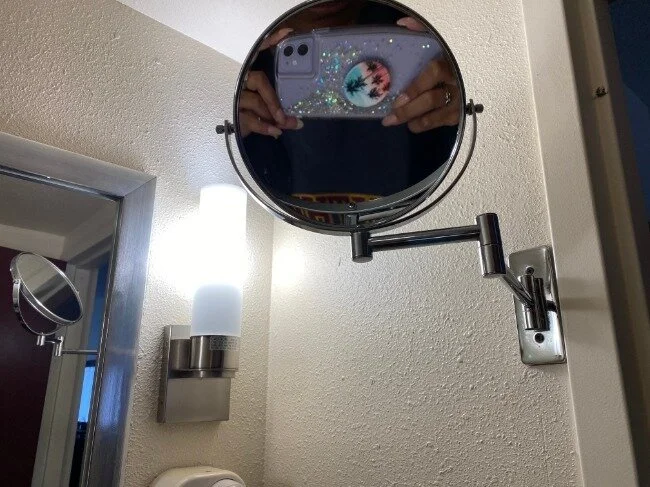
Image of magnifying side of the two-sided mirror showing a distorted reflection from my height.
I had high hopes but this is dead. 😔
UX Corner
In UX, there are rare instances that need to be accounted for when we design experiences. These rare instances are called edge cases. While I wouldn’t consider the particular scenario described in this post as an edge case (because there are plenty of shorter people in the world; therefore, experiencing what I experienced wouldn’t be rare or unlikely), it is a case that those in charge of this mirror’s installation did not (or chose not to) consider.
Ignoring edge cases can have varying consequences. Maybe it’ll result in the individuals who fall into those rare, unlikely scenarios being unsatisfied with what they experience. Or, perhaps the entire system will break as a result of its creators not accounting for something out of what was considered as “the ordinary.” Clearly, both of these potential consequences (and everything in between) can be detrimental to our products in some way. Because of this, it’s necessary that we account for things that we would not expect.

GIF of woman saying, “Expect the unexpected.” (credit: tumblr.com)
This can be tricky at times but a good way to start is by considering all of the types of users that could use our product, and not just the users whom we’d expect in a general case (i.e., a typical instance). As you may have picked up, identifying edge cases not only gives UXers an advantage; it also helps developers know and account for what may be possible. The last thing any of us wants to happen is for our system to catastrophically crash or collapse on itself because we didn’t foresee something that could have easily been predicted with a little more care and consideration upfront!